
Clearwater’s Surprising Railroad Past
Most people think of Clearwater as a beach town. However, the city has a richer transit history than many residents realize. In fact, Clearwater sits on ground that once hummed with railroad activity.
![The Orange Belt Railway heading to San Antonio [Photo courtesy unknown on Wikimedia. License: Public Domain]](https://metroposters.com/wp-content/uploads/2026/06/orange-belt-train.jpg)
The Orange Belt Railway arrived in the Pinellas peninsula in 1888. This was a landmark moment for the region. The line connected St. Petersburg northward and helped open up the entire peninsula to settlement. Clearwater quickly became a key stop along this growing network.
Peter Demens, the Russian-born railroad builder, drove much of this early expansion. His work transformed sleepy fishing villages into real towns. Clearwater, therefore, owes a meaningful part of its early growth to passenger rail service.
The Plant System and Clearwater’s Rail Heyday
![Advertising trade card for The Plant System railroad which once served Florida and the Southeast United States. [Photo courtesy unknown on Wikimedia. License: Public Domain]](https://metroposters.com/wp-content/uploads/2026/06/plant-system-railroad-trade-card.jpeg)
Henry B. Plant soon absorbed the Orange Belt Railway into his larger rail empire. The Plant System brought more investment and more passengers to the area. As a result, Clearwater gained better connections to Tampa and the wider state.
![Clearwater rail depot, 1910.
[Photo courtesy Florida Memory State Library & Archives. License: Public Domain]](https://metroposters.com/wp-content/uploads/2026/06/clearwater-florida-rail-depot-1910.jpg)
By the early 1900s, Clearwater had an active passenger depot. Visitors rode the rails down from the north to enjoy the Gulf Coast winters. The depot stood near what is now downtown Clearwater, close to Cleveland Street. Meanwhile, tourism was already becoming the city’s economic engine.
The Atlantic Coast Line Railroad later took over Plant’s network. It continued passenger service through Clearwater for several more decades. Furthermore, freight trains kept the local economy moving even as passenger numbers slowly declined.
Electric Streetcars and Early Urban Mobility
Rail was not the only form of urban transit shaping Clearwater. Electric streetcar systems spread across Florida’s cities in the early twentieth century. However, Clearwater itself never built a full streetcar network of its own.
The neighboring city of Tampa ran extensive streetcar lines that shaped its urban core. St. Petersburg also operated a notable streetcar system. In contrast, Clearwater remained smaller and more spread out. Its geography made dense streetcar infrastructure harder to justify economically.
This pattern is important to understand. Clearwater was growing, but not in the compact, walkable way that supports transit networks. Instead, the city spread outward along the peninsula. As a result, personal vehicles eventually dominated local travel, just as they did across most of Florida.
The Rise of the Car and the Decline of Rail
By the mid-twentieth century, passenger rail in Clearwater was fading fast. The automobile had reshaped American cities everywhere. Clearwater was no exception. New roads and bridges opened up access across Pinellas County and made driving the obvious choice.
The old downtown depot eventually closed. The rail corridor was abandoned for passenger use. Freight service lingered longer in some corridors, but even that wound down over time. Therefore, Clearwater entered the second half of the twentieth century as a fully car-dependent city.
This shift had lasting consequences. Clearwater’s urban form locked in around highways, strip malls, and parking lots. Cleveland Street, the historic main street, struggled to maintain vitality as retail moved outward. Urban planners and city leaders have been working to reverse these trends ever since.
Pinellas Suncoast Transit and Modern Bus Service
![SunRail train leaving Winter Park Station. [Photo courtesy Artystyk386 on Wikimedia. License: CC BY-SA 3.0]](https://metroposters.com/wp-content/uploads/2026/06/sunrail-train-leaving-winter-park-station.jpg)
Today, public transit in Clearwater runs through Pinellas Suncoast Transit Authority (PSTA). PSTA operates a network of bus routes across the county. Several key routes serve downtown Clearwater, the beaches, and connections to St. Petersburg.
Additionally, the SunRail commuter rail service operates in the Orlando area. It does not reach Pinellas County. This gap highlights a long-standing regional challenge. Clearwater and its neighbors lack any rail transit connection today.
Bus Rapid Transit proposals have come and gone over the years. The Greenlight Pinellas referendum in 2014 proposed a major transit overhaul, including light rail. However, voters rejected it. As a result, the county remains heavily dependent on its bus network and personal vehicles.
The Clearwater Ferry and Water Transit
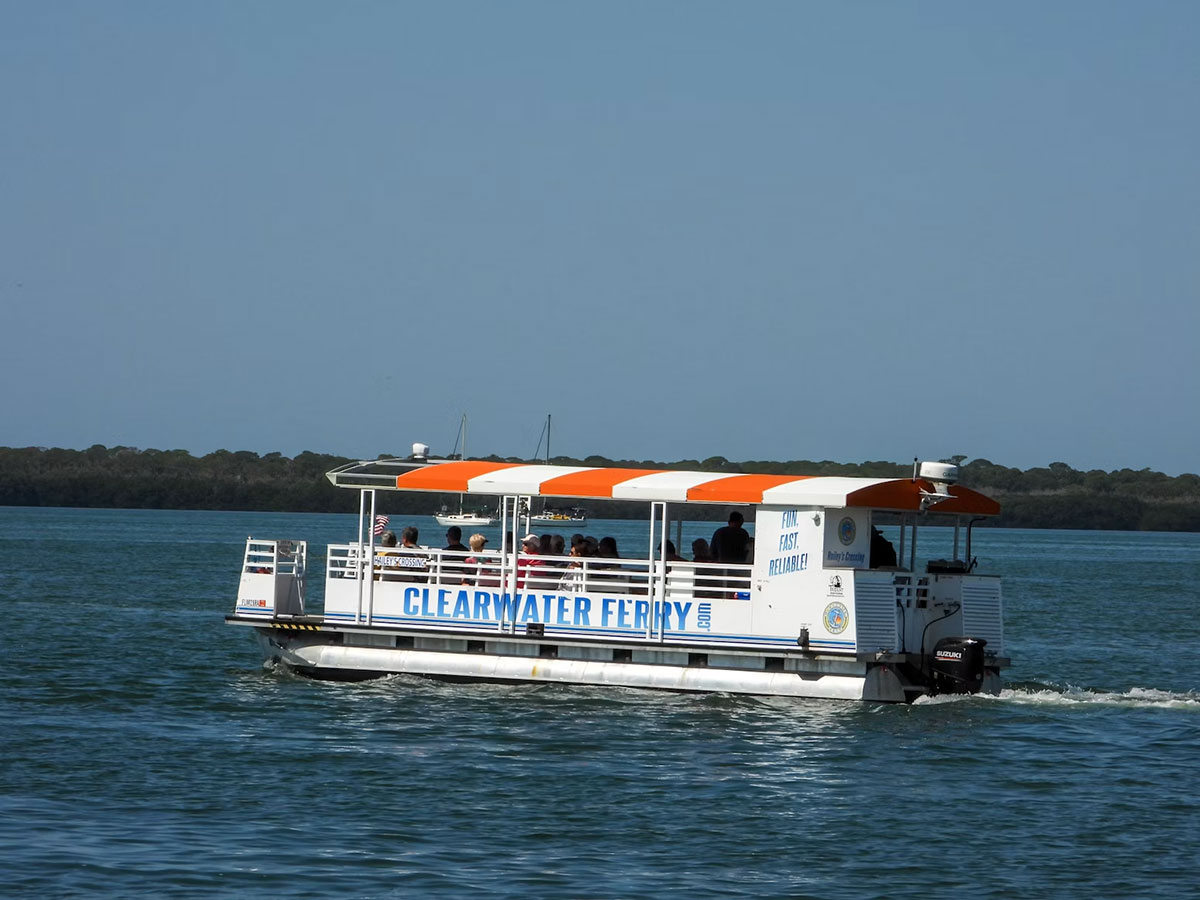
Not all of Clearwater’s transit history runs on rails or roads. The city also has a tradition of water-based transport. The Clearwater Ferry connects downtown Clearwater to Clearwater Beach today. It offers a fun and practical alternative to driving across the Memorial Causeway.
Furthermore, the ferry has historic roots. Water taxis and small passenger boats crossed Clearwater Harbor long before modern bridges existed. The barrier islands, including Clearwater Beach and Caladesi Island, depended on boat service for daily life. In fact, Caladesi Island remains accessible only by boat or ferry to this day.
This water transit tradition adds a unique layer to Clearwater’s mobility story. It reminds residents that the city has always had to solve the puzzle of moving people across its fragmented, water-cut landscape.
Downtown Clearwater’s Urban Revival Efforts
In recent years, Clearwater has invested heavily in revitalizing its downtown core. The Coachman Park redevelopment transformed the waterfront into a vibrant public space. The project reopened Clearwater’s connection to its beautiful harbor. As a result, downtown began attracting new residents, restaurants, and events.
Cleveland Street has seen renewed attention as well. The city has worked to add sidewalks, shade trees, and pedestrian-friendly streetscaping. These improvements signal a shift toward walkability. However, Clearwater still faces the challenges of a city built around the car.
Transit advocates continue to push for better connections between downtown, the beaches, and surrounding neighborhoods. The debate about light rail and bus rapid transit never fully goes away. Furthermore, as the Tampa Bay region grows, pressure for regional transit solutions increases every year.
What a Clearwater Subway Could Have Looked Like
Here is where imagination meets urban history. Clearwater never had a subway system. No city in Florida ever built one. However, thinking about what such a system might look like is a fascinating exercise.
Picture a line running from the Dunedin border south through downtown Clearwater. It would cross to Clearwater Beach via a tunnel under the harbor. Another branch could head east toward Countryside and connect to regional express service. Meanwhile, a coastal route could link Sand Key and Belleair Beach to the north-south spine.
Such a network would serve the tourist corridors, the growing residential areas, and the medical and employment centers scattered across the peninsula. It would finally give Clearwater the urban backbone its geography has always demanded. In fact, this kind of creative vision is exactly what inspired the Clearwater Metro Map at MetroPosters.com.
Why Clearwater’s Transit History Matters to Residents
Understanding Clearwater’s transit past helps explain the city today. The railroads brought the first wave of growth. The car culture that followed shaped every neighborhood built since World War II. Therefore, the lack of a metro system is not an accident. It is the result of decades of specific choices.
Notably, those choices are now being reconsidered. Climate concerns, traffic congestion, and housing costs are pushing cities to think differently. Clearwater is part of that conversation. The city’s leaders and residents increasingly recognize that walkable, transit-connected neighborhoods offer a better quality of life.
For city-proud locals and urban history enthusiasts, this history is worth knowing and worth celebrating. It tells the story of a city that has always been shaped by how its people move. Furthermore, it opens the door to imagining a different kind of future.
Celebrate Clearwater’s Urban Story with MetroPosters
Clearwater may not have a subway yet, but that does not mean its transit story lacks ambition. From the Orange Belt Railway of 1888 to the modern ferry crossing Clearwater Harbor, this city has always found ways to connect its people and places. MetroPosters.com celebrates that spirit with beautifully designed fantasy transit maps. The Clearwater Metro Map imagines the rapid transit network this vibrant Gulf Coast city deserves. It makes a perfect gift for any proud Clearwater resident, local history lover, or urban planning dreamer. Hang it on your wall and imagine the city that could be.
Cover Photo by Unknown, Vintage Postcard, Public Domain.


0 Comments